

.jpg)

The College Innovation Network (CIN) at WGU Labs was founded in 2019 to help a consortium of higher education institutions navigate uncertainty in an increasingly tech-enabled world. Throughout this time, we helped over 15 member institutions — with their diverse student bodies totaling 300,000 — adapt to a world where technology was suddenly at the forefront of learning.
Initial funding from the Charles Koch Foundation for CIN spanned two years, with a generous and welcomed expansion granted for an additional two years in 2022. Throughout our four-year partnership, we aimed to lift up the experiences and voices of students, faculty, and administrators as they grappled with rapid technological and institutional changes during and after the pandemic. Among other initiatives, we launched our EdTech Survey Series with that goal in mind.
Across three student surveys, two faculty surveys, and an administrator survey, we had a front-row seat to the way over 33,000 higher education stakeholders understood and responded to the changing tools and expectations across CIN member institutions.
As CIN transitions to a new phase, we’re looking back on the key takeaways and central themes from our EdTech surveys in this retrospective series. We’ve identified year-over-year trends and intersecting themes that we hope provide the industry with more insights into the pivotal role technology plays in the educational experience.
Year-Over-Year Trends
When we released our first Student EdTech Survey in the summer of 2021, the majority of higher education institutions were in survival mode after the COVID-19 pandemic forced a rapid shift to online learning. In the years that followed, the conversation has evolved to consider the ways technology can drive the future of learning. In 2021, one of educators’ biggest priorities was simply ensuring access to online learning via reliable wifi and devices, as well as EdTech self-efficacy — or students’ confidence in their ability to use new tools and technology. Just three years later, we’re now pondering the potential of artificial intelligence to dramatically transform the learning experience all over again.
Students' EdTech Self-Efficacy
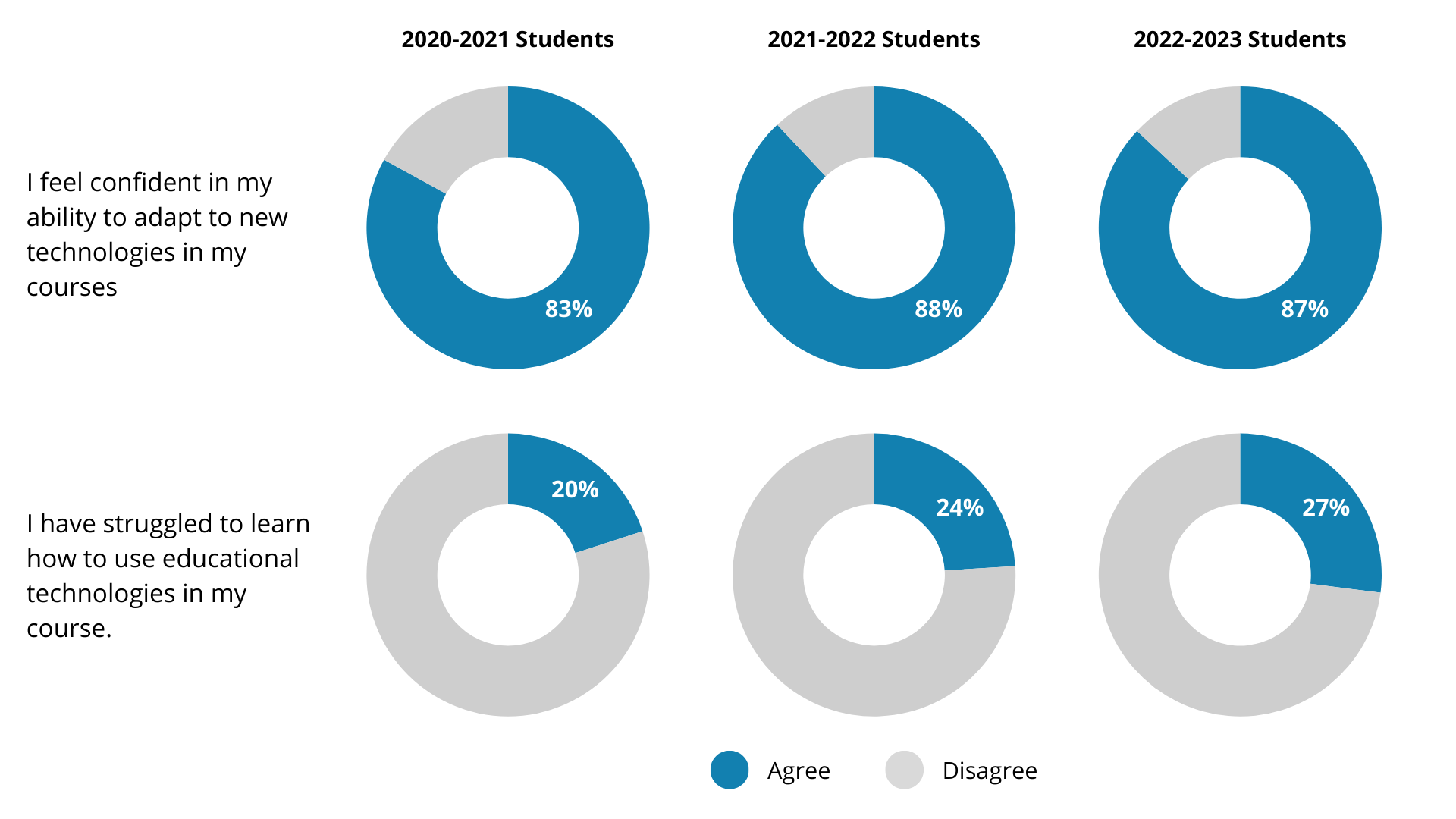
Across the years, we have found that, while most students are confident in their ability to use EdTech, a small but meaningful proportion remain unconfident.
Faculty's Views on the Future of Higher Education

Across the years, faculty have remained positive about expanding modality and credential options for students in the future, with notable gains made in the most recent survey.
Administrators' Views on the Future of Higher Education

The majority of administrators are similarly positive about offering students more modality and credential options in the future, but are less enthusiastic about expanding online options.
Students' Views on the Future of Higher Education

Across the years, students were also positive about the possibility of more modality and credential options in the future and notably more positive about online options than both administrators and faculty.
Intersecting Themes
After reviewing our surveys across groups — students, faculty, and administrators — we also identified several intersecting themes that emerged over the years:
- Technology’s role in the future of higher education: Faculty and administrators see the value in EdTech, but feel little control, low confidence, and a lack of agency over its implementation and usage, leaving us to wonder: Is the future of higher ed tech-enabled or tech-controlled? While technology is often touted for its ability to deliver more effective, personalized teaching and learning experiences, our data shows that many faculty fear a future of learning that’s more standardized as a result of technology — and administrators aren’t confident in their ability to select effective tools.
- The unfulfilled promise of technology in higher education: Technology has long been hailed as a means to make our lives better. And there is no doubt that EdTech has helped improve outcomes for students. Our data shows that, among other benefits, technology in higher education can be valuable for expanding access and engagement for learners from under-resourced groups — particularly first-generation college students. Yet the vast majority of students and faculty reported experiencing tech fatigue and burnout. For EdTech to truly fulfill its promise, we need to address issues around psychological and emotional well-being.
- Innovation catch-22: Currently, only 7% of EdTech companies provide evidence of their product’s efficacy. Higher education decision-makers don’t want to risk implementing unproven solutions when student outcomes are on the line. EdTech startups, therefore, struggle to attract clients from which to gather evidence of their solution’s efficacy. And higher education ends up sticking to the status quo.
- The uncertainty crisis in higher ed: Respondents across our surveys expressed split views around in-person vs. online learning, tech promise vs. fatigue, the future of higher education, and AI’s role in education. For example, many students and faculty are experiencing tech fatigue. Yet, they’re also excited about a future of higher education with more online options. Decision-makers are largely choosing inaction in the face of all this uncertainty. These findings align with larger inconsistencies across the industry, such as record-low faith in the value of higher education despite its proven value.
We’ll explore each of these themes in subsequent parts of our retrospective series. Follow us on LinkedIn or subscribe to our newsletter to stay up to date.